Why should you care about the gender make-up of your team? Because it’s good for your bottom line. It’s also the right thing to do, but let’s stick to the commercial case for now.
The gender pay gap measures who is in which roles, at what level, and who stays. Reducing it means more women in senior and higher-paid roles, and a workplace where they choose to stay. So the commercial case for reducing your gap is the commercial case for a gender-balanced business, and that’s what the following six reasons cover.
Things are hard out there in agency world right now. Some simple changes to your processes, policies and culture could be the thing that delivers the commercial impact you’re looking for. Most of them cost very little, and all of them start with knowing where you are now.
1. Better financial performance
Businesses with more women in senior roles tend to perform better financially. The research I find most convincing is McKinsey’s, because they’ve repeated it. Four times between 2015 and 2023, they’ve compared companies with the most gender-diverse executive teams (the top quartile) with those with the least (the bottom quartile), and asked how much more likely the top group is to outperform on profitability.
The answer has grown every time: 15% in 2015, 21% in 2018, 25% in 2020 and 39% in 2023. The advantage has more than doubled, and the sample has more than tripled, from 383 companies to 1,265.
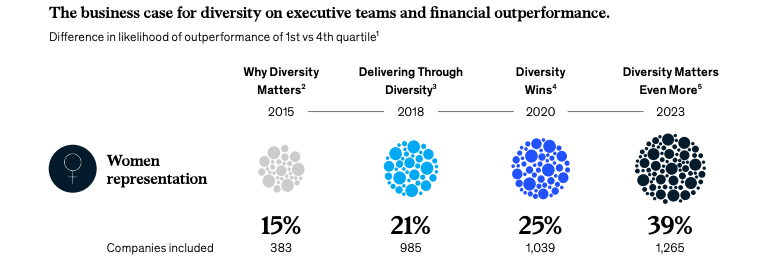
Source: McKinsey & Company, Diversity Matters Even More (2023). Difference in likelihood of outperformance, top vs bottom quartile of gender diversity on executive teams
S&P Global Market Intelligence (2019) analysed almost 5,800 executive appointments at US-listed companies and found that, over the following 24 months, female CFOs were associated with 8% larger stock returns.
There’s an opportunity for agencies here, as the agency data points the same way. Agency by Agency’s Atlas (2026) shows women-led agencies generating £2,280 more gross value added (GVA) per head than men-led agencies (£95,475 compared with £93,195). Yet, only 19.7% of agencies are women-led. Agencies with mixed-gender leadership do best of all, at £98,230 per head, £5,035 ahead of men-led agencies.
2. Win the clients you really want
Large companies are no longer assessed only on what happens inside their own walls. They’re increasingly judged on their whole supply chain, including every supplier they work with, and that includes their agencies.
You might be too small to report on your gender pay gap, but your biggest potential clients aren’t. They have to account for the people and businesses they buy from, and they need to be able to show that those suppliers are ethical. That’s why supplier questionnaires and pitch processes now ask about fairness, inclusion and responsible business.
A clear answer, backed by your own numbers, makes you easier to buy from. An agency that can’t give one makes the client’s job harder. For some clients, it could be your invitation to the table.
3. Better decision-making
Agencies sell thinking. Every pitch, campaign and strategy comes down to a group of people deciding what will work for a client and their audience. If everyone in that room has the same background and the same blind spots, you’ll keep arriving at the same answers.
The research backs that up.
Cloverpop’s research (2017) analysed around 600 business decisions made by 200 teams over two years. It found that:
gender-diverse teams made better decisions than individuals 73% of the time
compared with 58% for all-male teams.
When the teams were also geographically diverse, that rose to 87%.
4. Attract top talent
The best people have choices, and many of them are choosing carefully. They want to work somewhere that takes gender equality seriously, with fair pay, clear progression and a leadership team that looks like the people it leads. An agency that can show it does has an advantage, because those candidates see it before they ever apply.
That’s good for business. A wider pool of applicants means more choice, and more choice means better hires. It’s also a bigger pool of experienced women, many of whom are returning from leave or looking for somewhere that will let them progress. A day off for your birthday won’t attract them. A workplace that has done the work will.
5. Protect your employer brand
Agencies understand brand. You wouldn’t let a client’s brand drift, and your own culture is part of yours, whether you manage it or not.
People form a view of you in a lot of places before they ever speak to you: your leadership page, your job ads, your team photos, your impact report and what your former staff say about you. I’ve spent a lot of time on agency websites and impact reports, and what’s there often says more than the agency intended. A statement about inclusion next to an all-male leadership page doesn’t land. A pay gap figure with no explanation of how it was calculated raises more questions than it answers.
I understand why so many agencies say nothing at all. Nobody wants to get it wrong, so it feels safer to stay quiet. But silence leaves people guessing, and what they guess is rarely kind. An honest “this is where we are, this is what we’ve found and this is what we’re doing about it” does far more for your reputation than a polished statement, or no statement. You don’t need a perfect gap or a finished plan. You need to be straight about where you are and show that you’re working on it.
You may also be doing great things already that nobody knows about. Knowing your numbers, and being able to say what you’re doing about them, gives you something real to share.
6. Improved staff retention
Recruitment is expensive, and losing people costs more than most agencies realise. Attrition in creative agencies is 24.9% (IPA). In a team of 20, that’s five people leaving every year, and replacing each one costs around £12,000 (Accounts & Legal, 2025). That’s before you count the lost client trust, team knowledge and momentum, which are much harder to price.
Women tend to leave at predictable points: after having children, and again around menopause. Those are moments you can do something about, and doing something costs far less than replacing someone.
Inclusive workplaces tend to hold on to their people. A study of 499 organisations over 14 years (Maurer and Qureshi, 2019) found that organisations which rapidly increased the representation of women saw significantly lower staff turnover, for men as well as women.
Meeting the legal minimum keeps you compliant. Going further keeps your people.
Where to start
You can’t improve what you don’t measure, and the gender pay gap is where that starts. The numbers often show exactly which parts of your business to look at, across recruitment, retention, recognition, reputation and reach.
If you’d like help with any of that, just get in touch.
My gender pay gap calculation and analysis service gets you that benchmark data.
If you’ve got the data and want to know how to improve it, Default to Designed is my signature 6-month cohort programme, built around those five areas. Cohort 2 starts in January, and places are deliberately limited.
