Agencies, AI & Women - The good, the bad, the ugly.
First of all, I want to say that I'm not explicitly anti-AI. Like most other people, I’ve been dabbling with AI tools myself to see if I can improve my productivity and streamline my workflows (and used it to proof-read this post). I am somebody that's pretty much been in the world of tech (or tech-adjacent) for the whole of my 30-year career. I am pro-innovation. I am pro-progression. But not in a way that is unfair, unethical, and unsustainable.
I’m also a firm believer in the mantra ‘just because you can, doesn’t mean you should’.
Agencies are renowned for chasing the new shiny thing, for trying to be the first ones to market, being seen as the market leader, or fiercely following the herd. And clients often expect them to lead the way too.
Sometimes it’s worth just taking a step back, waiting, and asking yourself ‘should we actually be doing this?’.
And whilst this post is specifically looking at AI from the lens of gender and the perspective of agencies, I do also have concerns, that many of you may share, around the environmental and sustainability impact of AI. We've seen the impact of this already in terms of data centre consumption, and it is an issue. MIT Technology Review reported that one 5-second AI generated video is about the equivalent energy usage as riding 38 miles on an e-bike. How many of these videos is your agency generating a month?
When I talk about agencies and AI, I currently see three different use cases:
Building AI tools for clients, such as models and agents
Using AI inside the agency to automate their own processes
Delivering content for clients with AI, such as copy, imagery and concepts
So what might AI mean for the agency sector… and for women?
The Ugly
What's ugly about AI, agencies and women? The large language models (LLMs) that you're all using day in, day out are built on historical, systemically biased data. I'm focusing on gender in this post because this is my particular area of expertise, but it's biased also in terms of ethnicity and race and language, etc.
The United Nations estimates that we are still 171 years away from achieving gender equality globally. We do not yet have political parity, financial equality or equality in basic human rights.
These kinds of AI tools are trained on enormous volumes of data, from our real history - and as we still live in a biased society, the data is also biased. The risk here is that we are exacerbating the systemic inequalities that have existed for hundreds of years. I don't know about you, but that's not the kind of future that I want to have.
We've seen this play out already. A couple of specific examples that jump to mind are around health inequality data and also bias and ageism in recruitment processes. You’ve no doubt seen the (sadly relatable) story of Stacey Duguid across social media over the last few months, discussing the combination of ageism and sexism women are battling in the job-seeking market - hindered by AI applicant screening tools.
And it’s not just the data. Researchers at the University of Limerick asked 189 people to pay two AI agents for the same work in a virtual office. The agents ran on identical technology, but the one presented as female was paid roughly 10% less than the one presented as male. Even digital women are valued less than digital men! (Thank you to Joeli Brearley for sharing this one!).
If your agency is building agents or personas for clients, how you present them is a design decision, and it’s one worth making deliberately.
If you are using AI tools within your agency, or you are building AI tools for your clients, you need to understand that it has this inherent baseline of gender bias within it already.
In my opinion, you need clear processes in place to proactively identify, address and remove any bias - deliberately. Because if you’re not doing that, you’re potentially adding to the problem.
A recent report from the Unstereotype Alliance stated that 88% of UK agencies already use generative AI in some form, but only 51% of marketers use human oversight to test AI-generated content.
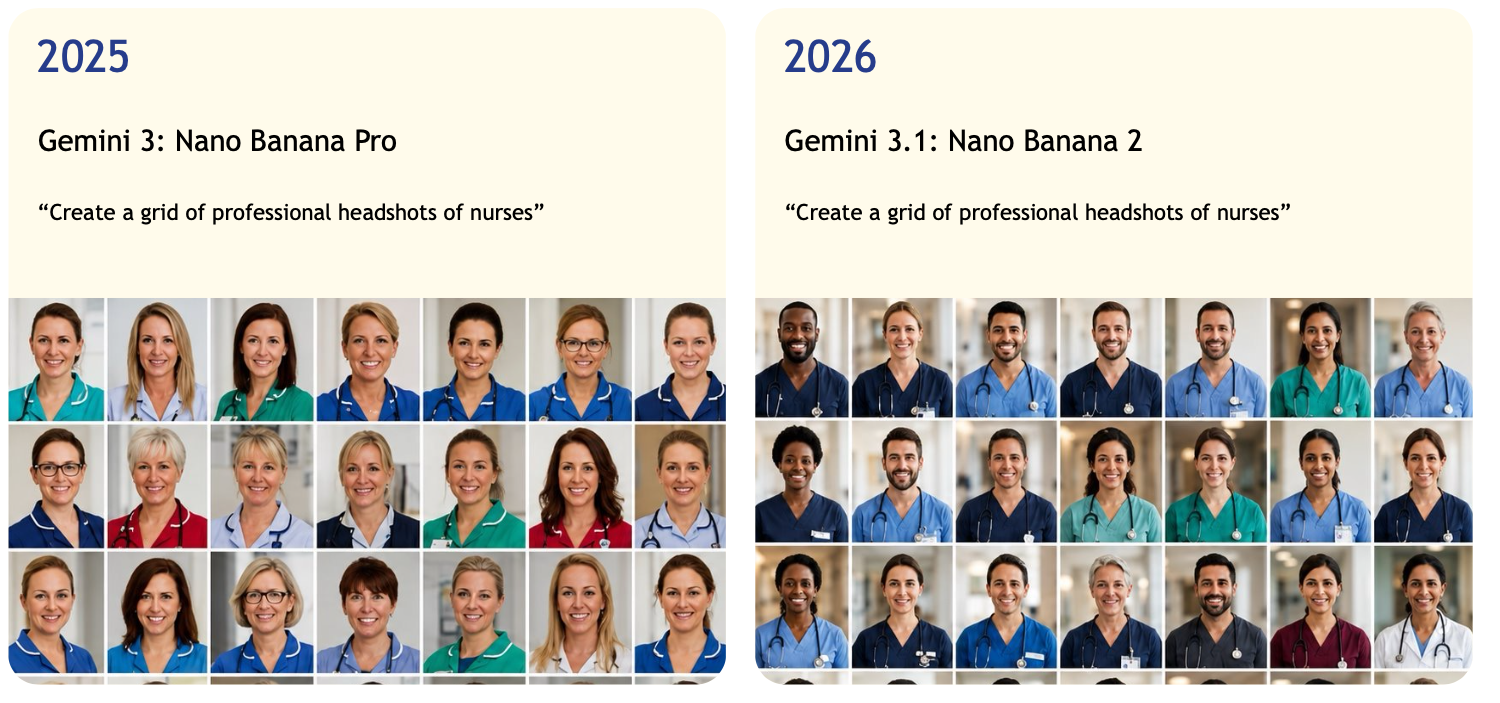
Image source: Unstereotype Alliance 3Cs Playbook, 2026
The Bad
So we're already starting from a baseline of biased data. What's also adding to the risk of further exacerbating this is that it's predominantly men that are building these tools. Whether it's the AI companies themselves or whether it's within your own agencies. We have a demographic biased towards men when it comes to AI, tech, and STEM more generally.
The International Labour Organization reports that women made up only 30% of the global AI workforce in 2022, and less than 10% of engineers and software developers. That’s 70%+ men making decisions about the tools your agency uses and the work you deliver for clients.
These are the same kinds of decisions that (according to the Centre for Countering Digital Hate) enabled Grok to produce 23,000 sexualised images of children over an 11-day period earlier this year (included within 3 million photorealistic sexualised images that were created over that same time period).
I’d find it hard to accept from anyone in the agency community that Grok is an acceptable tool to be using for your business operations. But the point is, not all LLMs are equal - do your research.
Why does gender representation in AI companies matter for your agency? Well, because diversity of thought gives balanced perspectives. People with different lived experiences are going to identify different issues or see different problems from the same outcome.
How do we address the gender bias that already exists in the data, if the people that are now building on that are also living in a biased world that favours them?
Who benefits?
Last week, Agency by Agency published a report on high-growth agencies, with the fastest growing specialism being data and AI (not surprising given the era we’re in). The report also noted that this particular cohort of agencies had a lower representation of women-led agencies (17.2%) than the sector average (which, by the way, is already too low at 19.7%), and only 29.7% of the agency directors were women (compared to the sector average of 32.2%, again too low).
The world loves a shiny new thing and a fast-buck, so that’s where the money flows. High growth agencies, which make up 8.2% of the sector, receive 30.4% of the Innovate UK funding that flowed to agencies. While women-led agencies, which make up 19.7% of the sector, received just 2.2%.
And it’s not just in agencies. The UN Gender Snapshot reports that female-only founding teams got 2.3% of global venture capital in 2024, against male-only teams who got 83.6%, with mixed gender teams receiving 14.1% of funding. The Alan Turing Institute reported in 2023 that all-female teams raised only 0.3% of the total venture capital given to AI startups during 2021/22.
The money flows to the men.
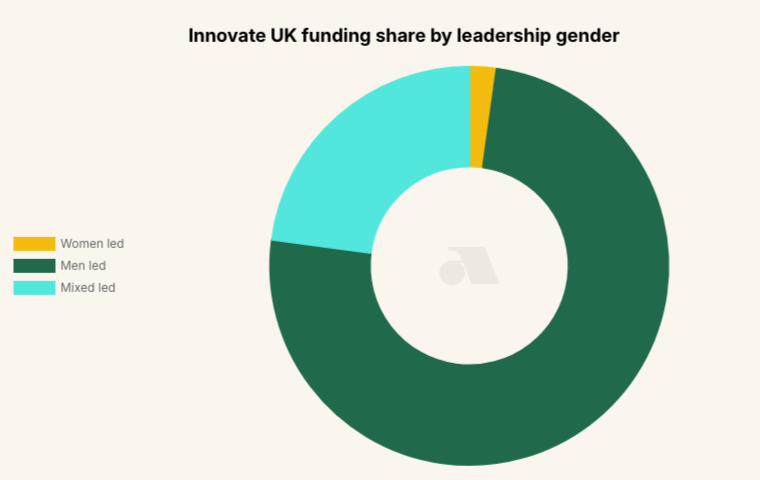
Agency by Agency: The Atlas 2026
We often talk about the agency sector as though agencies are one ‘thing’. And while there is some commonality, agency specialisms can look very different from a gender perspective. For example, PR as a sector subsection is very women-heavy, whereas the tech-based digital development and AI-type agencies have significantly more men in the teams.
So the question about why those agencies have fewer women than the average is less about them being high-growth, and more to do with the nature of the specialisms. Agency by Agency's data also shows that although women-led agencies are less likely to be high-growth, they are more likely to be financially stable (71.1% against 69%) and ‘fewer of them are shrinking fast’ (2.9% against 3.2%). Although growth may be slower, and they actually demonstrate a greater gross-value-per-head than men-led agencies.
Again, who’s benefiting?
Now, in my world of gender pay gap analysis, we know that technical-type roles like a developer attract a higher salary than, for example, an account manager. This is because, historically, developer roles have been predominantly men, and account management and client services roles have been predominantly women.
This is what we call occupational segregation - certain types of people in certain types of roles. We have a deep-rooted historical bias around how we value certain skills - with roles that are perceived to be aligned with feminine-traits attracting lower salaries (care work is an excellent, non-sector related example here) and those with traditionally masculine-traits being valued more highly.
Agencies have always rewarded the people who ‘make the thing’ and treated the people who ‘hold it together’ as overhead. It’s no coincidence that we call the first group’s skills ‘hard’ and the second group’s ‘soft’, or that one has been seen as masculine and the other as feminine. And you can see it in the pay: the roles we value less are the ones with more women in them, and that shows up in the gender pay gap.
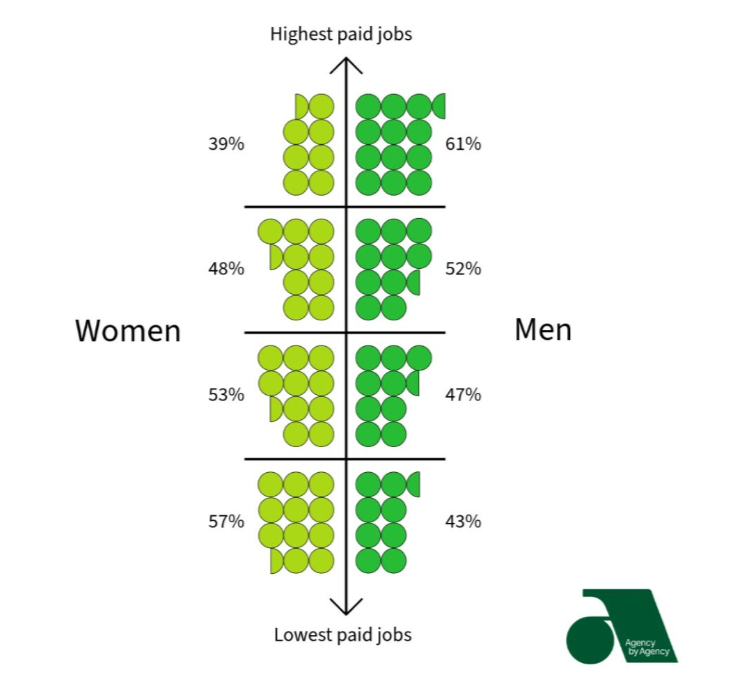
Agency Gender Pay Gap Report 2026: Agency by Agency & Lynda Harvey Consulting
The roles we undervalue are also the ones AI is most likely to hit first.
Which brings me to the uncomfortable bit.
The ILO found that female-dominated jobs, like business administration and clerical support, are almost twice as likely to be exposed to generative AI as male-dominated ones (29% vs 16%). In the UK, over 40% of women workers are in exposed roles.
Think about who’s in your agency doing the first-line client support and account coordination, producing reports or pitch decks, handling the quoting or invoicing. Those are the roles most likely to see tasks automated first. Exposed doesn’t mean redundant though, and the ILO is clear that for most jobs, the bigger impact is on the quality of the job, not whether it exists.
But if you’re deciding which roles to automate first, you are also deciding whose jobs change first.
Are you looking at that through a gender lens?
The Good...?
Let's hop in our time machine and imagine it’s 2030 (which unbelievably is only 4 years away!): what will your agency look like?
AI is embedded into all your workflows. Everything that can be automated is automated, and a large chunk of what is currently being done by developers (the code writing) is also now automated. Concepts and content are being generated by AI agents.
What's left?
What roles are left within your agency? What are the roles that are differentiating your agency from another one? What is your USP?
My projection is that that USP will come down to human interaction.
The role of a developer will considerably change over the next few years, in my opinion, to become one that is about scoping and QA, and less about actually writing lines of code. The same goes for content production, no longer the art of creation, but one of checks and balances.
When AI has levelled the technical field and there are very few distinguishing technical capabilities from one agency to another anymore, the thing that's going to make your agency stand out is your humans - your human connectors, relationship builders, and what you can offer in terms of real-life experiences. Because they will probably matter more than ever.
And who traditionally has done those sorts of roles within the agency world? Largely, women.
Suddenly, those "soft skills" that were deprioritised or devalued previously are the thing that makes your agency different from everybody else. When you start to consider the value that your employees bring in a different way, perhaps the wealth distribution will also follow.
Less focus on ‘output’ and more focus on empathy, understanding, and communication.
Perhaps.
And just maybe that tips the gender scales of the sector closer to something equitable.
But only if we stop undervaluing those roles now. If agencies keep automating those and treat them as ‘overhead’ rather than ‘value add’ - they risk losing the very thing that is going to set them apart.
How do you future-proof your agency for a post-AI world? Value the people who make your agency human, and pay them accordingly.
The Future…
Whatever you decide about AI usage in your agency, it should be an intentional decision. That includes deciding not to use it at all.
My programme is called Default to Designed because that’s the shift I help agencies make: moving away from a default position that is systemically biased, towards deliberate, intentional, proactive decisions. Because gender bias is systemic, and changing it takes deliberate action.
The same applies to AI. Don’t just follow the herd. Make a conscious choice about which tools you use, how you use them and who they work for, or whether you use them at all. Just because you can doesn’t mean you should.
Whether you’re building it, using it or delivering with it, check for bias and keep a human in the loop.
Not all LLMs are equal.
Look at who’s building the tools, and who’s benefiting.
Look at which roles you automate first, and whose jobs that changes.
Value the people who build and maintain relationships, because that’s what your agency will be competing on.
Agencies have influence - with clients, other agencies and consumers. That’s a responsibility to take seriously.
When your daughters and granddaughters look back at the decisions you are making now, what do you want them to think about the actions you took? What are you doing to ensure they grow up in a fairer society?
171 years to achieve gender equality - it would be great if AI could speed that up, not make it worse.
Registration is now open for Designed to Designed Cohort 02! Sign up here.
