How does the gender pay gap in the agency sector compare with the rest of the UK?
Agency by Agency mapped more than 25,000 UK agencies and combined that with the gender pay gap submissions from agencies large enough to have to report. I worked with them on the analysis. The full report is here.
The headline number gets the attention, but I think the detail underneath it says more, so here’s what I took from it.
83p in the pound
Across the 74 large agencies, women’s mean hourly pay is 17% lower than men’s. That’s 83p for every £1, or £6,800 less a year on a £40,000 salary. The UK mean is 14.3% (ONS, 2025). The median tells the same story, with 56% of these agencies above the UK median of 12.8% (ONS, 2025). However you slice it, agencies are behind the national picture.
The pay quartiles show where the gap comes from
Women hold 57% of the roles in the lowest pay quartile, falling to 39% in the highest. Women are in these agencies, but they’re clustered at the bottom of the pay structure. Most of the gap comes from who gets hired into which roles and who gets promoted. Two people doing the same job on different salaries is a much smaller part of it.
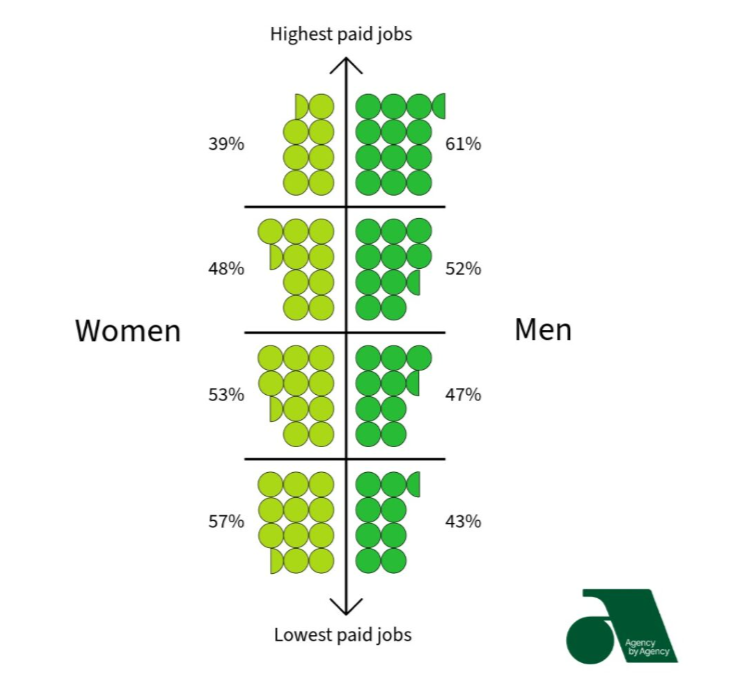
Source: Agency by Agency, “83p in the pound” (Feb 2026).
Occupational segregation is doing a lot of the work
The quartile split points to what’s sitting behind the gap, which is occupational segregation. That means men and women tend to end up in different types of roles, and the roles they cluster in are paid differently. It works in two ways: horizontally, across different jobs, and vertically, up the seniority ladder. As well as lack of women in leadership, we often see this in agencies as women in the (lower-paid) customer-facing client services type roles, and with more men in the (higher-paid) technical development and strategic roles.
That’s why a pay review alone rarely closes the gap. Two people doing the same job can be paid fairly, while the jobs themselves are split along gender lines. It also makes this a hiring and progression question. Who applies for which roles, who gets the interview, and who gets promoted into the roles at the top all shape these numbers.
“We have equal pay, so we can’t have a gap”
This is the misconception I hear most from agency leaders. Transparent pay bands and a fair salary for each role are good things, but they don’t tell you who holds the senior, higher-paid roles. You can pay everyone fairly for the job they do and still have a significant gap.
The bonus gap is bigger than the pay gap
42% of women and 44% of men received a bonus, so access looks similar. But women’s mean bonus was 24% lower (76p in the £1), which is bigger than the 17% hourly gap. When that happens, it usually points to who has access to the larger incentive schemes, which tends to follow seniority.
Leadership is part of the picture
At the time of the report, 19.4% of agencies were women-led and 30.7% of directors were women. Many of the women-founded agencies I know were started to build a business around their own needs, including family life. That tells you something about the agencies they didn’t stay in.
What this means if you run a smaller agency
These 74 agencies are 0.3% of the agencies mapped, but they employ about 1 in 5 of the sector’s people. Smaller agencies may well see different patterns. The question is still the same, though: what’s driving the gap in yours?
If you’d like to know your full numbers, take a look at my gender pay gap analysis service.
Read the full report: Agency by Agency report
As Featured in:
The Drum; The Media Leader; PR Moment
Update, 26th Oct 2026: Agency by Agency’s newer Atlas data puts the share of women-led agencies at 19.7% and women directors at 32.2%.
ONS has also since revised its 2025 median gap to 13.0%, with a first draft 2026 figure of 12.3%.
